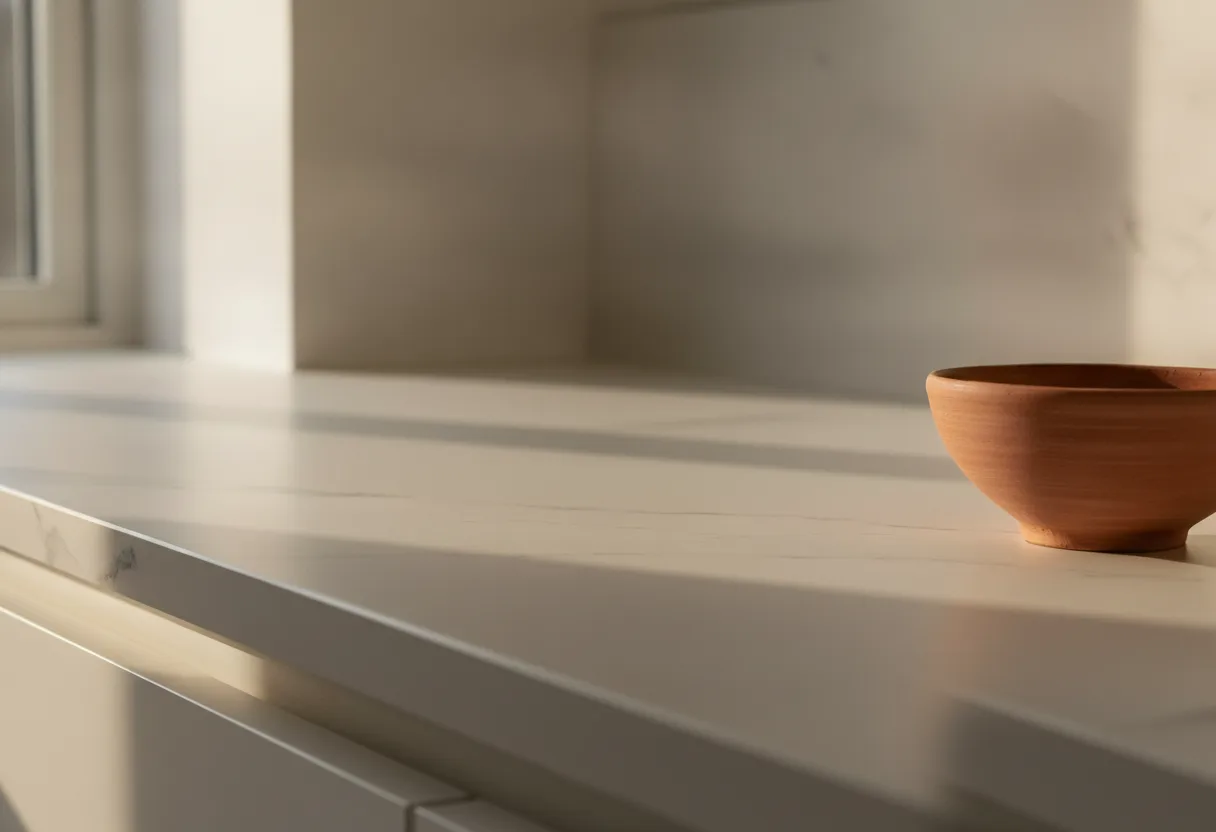
Corian and solid surface worktops explained by kitchen designers in Edinburgh and Glasgow: what the material gives you, and where quartz genuinely wins.
Ask what a premium kitchen worktop should be made of and you will hear one answer more than any other: quartz. So it surprises people that our range is built around a different family of materials entirely.
Our worktop range centres on Corian and its solid surface relatives, and in design conversations across Edinburgh and Glasgow the same question comes up almost every time: why not quartz? It deserves a straight answer rather than a sales one, especially because a handful of our own finishes have the word quartz in their names.
So here is what solid surface actually gives you, where quartz genuinely wins, and how to decide which belongs in your kitchen.
What Corian Actually Is
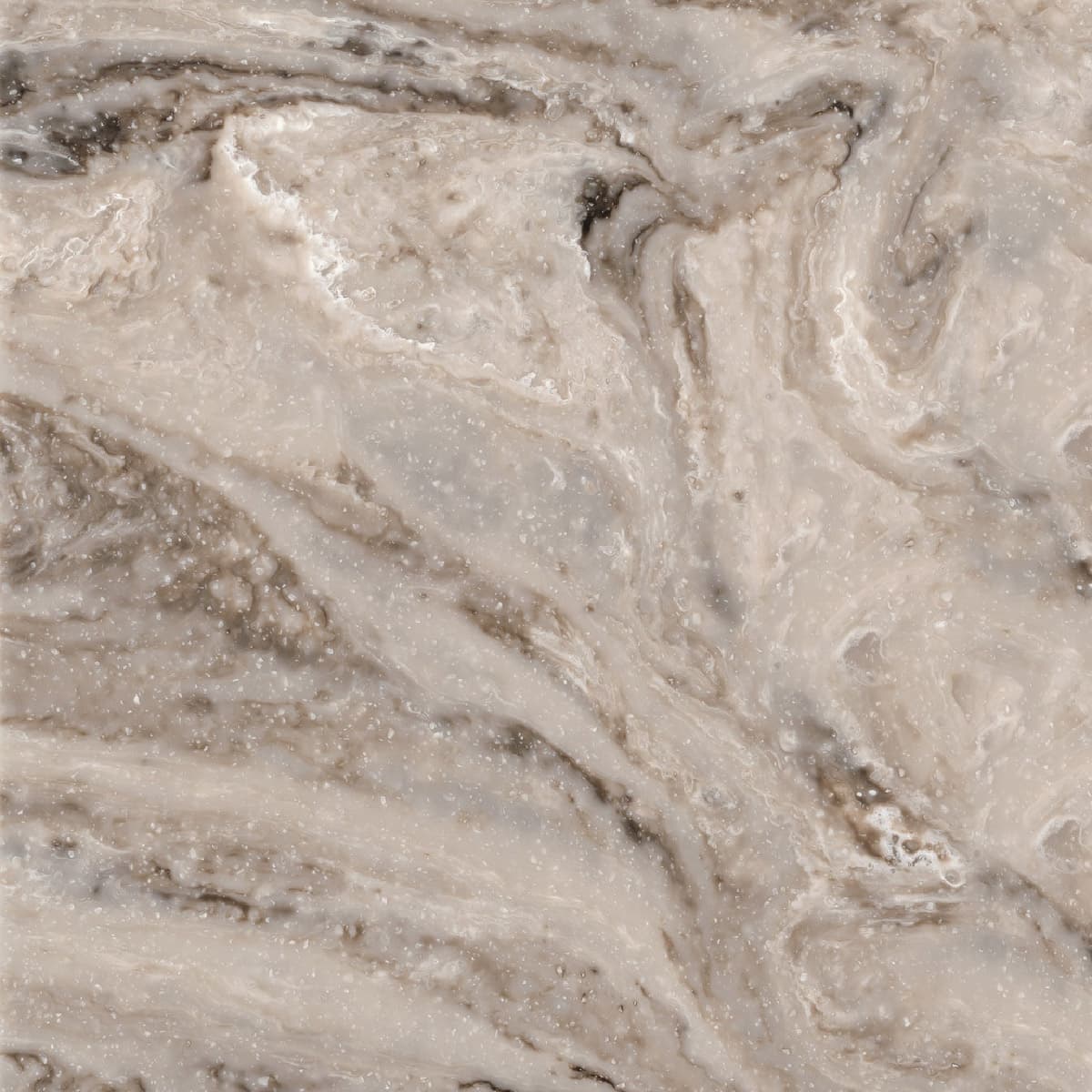 Smoke Drift Prima: one of the veined Corian finishes in our range.
Corian is the original solid surface material, developed by DuPont in the 1960s: acrylic resin blended with natural minerals and cast into slabs. The colour runs through the full thickness of the material rather than sitting on top, which is the quiet fact behind almost everything else that makes it good.
Corian is also just one name in the family. Alongside it we work with LG HI-MACS, Staron, Hanex, Tristone and Durasein, plus the recycled glass surfaces that get their own full write-up. Across those brands, our worktop range runs to more than 450 finishes, from plain whites to marble-style veining to bold flecked colour.
Quartz, for comparison, is engineered stone: crushed natural quartz bound with resin. It is a genuinely good worktop material, and we will get to its strengths honestly. But the two materials behave very differently once they are in a kitchen.
What Solid Surface Gives You That Quartz Cannot
Joins you cannot find. Solid surface is bonded and polished so that a long run, an island or an L-shaped return reads as a single piece. A quartz worktop of any size will always have visible join lines. In a kitchen built around clean, uninterrupted surfaces, this is the difference you notice every day.
Shapes stone cannot make. The material can be curved, and upstands can be coved in a continuous sweep from the worktop, so there is no silicone line at the back edge to darken over the years.
A sink with no rim. Because sinks can be bonded straight into the surface, there is no lip to trap crumbs or water. If you have ever cleaned around a conventional inset sink, you will understand the appeal. Our sink range includes integrated options designed for exactly this.
Repairs, not replacements. Everyday scratches, marks and light scorches can be sanded out of solid surface, because the colour goes all the way through. A chip in quartz is there until you fill it. Ten years in, this matters more than any comparison of two fresh samples suggests.
Warmth. Solid surface is warm to the touch in a way stone never is. It sounds like a small thing until you lean on the worktop on a January morning in a Scottish kitchen.
Where Quartz Genuinely Wins
We would rather tell you where quartz beats our material than pretend otherwise.
Quartz is harder. It resists scratches better than solid surface, and it shrugs off more day-to-day abuse without marking in the first place. It also tolerates heat somewhat better, although the resin in both materials means neither wants a hot pan straight from the hob; the trivet advice is the same either way. And if what you love is the cold, dense, stone-under-hand feel, quartz is simply closer to that than an acrylic surface will ever be.
What tips our judgement is what happens over a worktop's whole life. Quartz starts harder; solid surface stays repairable. One resists the first scratch better, the other can have the tenth scratch polished away. We build our range around the material our own workshop can template, join, shape and renew, because that is where a worktop earns its keep over a decade or two.
Why Some of Our Finishes Have “Quartz” in the Name
 Deep Black Quartz: a Corian solid surface finish, named for its quartz-like sparkle.
Browse our worktop range and you will find finishes called Deep Black Quartz, Sea Oat Quartz, White Quartz and Frost Quartz. Every one of them is solid surface, not engineered stone.
Manufacturers name decors after the look they achieve, and these finishes carry a fine crystalline fleck that catches the light the way quartz crystal does; the name describes the sparkle, not the recipe. It is the same convention that gives us Carrara-named finishes containing no marble and concrete-effect finishes containing no cement.
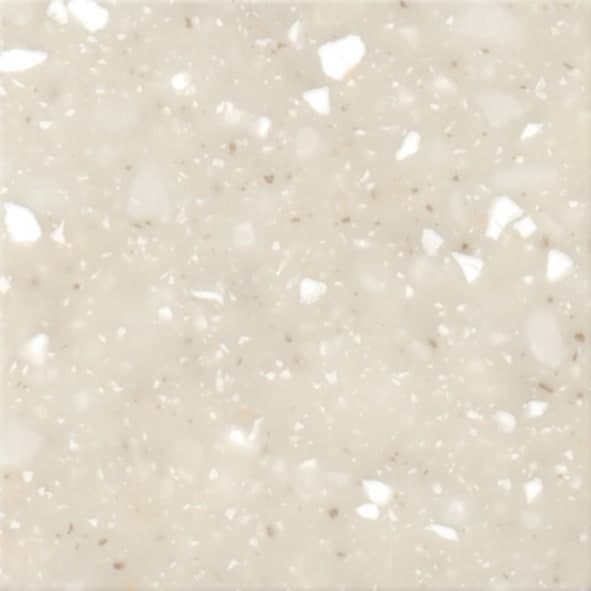 Sea Oat Quartz: an LG HI-MACS finish, warm oat with a soft terrazzo-style fleck.
We would rather explain that plainly than have you discover it mid-quote. If you want the quartz look, several of our finishes deliver exactly that sparkle. If you want engineered stone specifically, we are honest about the fact that we specialise in solid surface, and your designer will say so to your face.
What a Corian Worktop Costs
The unhelpful answer is “it depends”, so here is what it depends on:
- The finish. Decors within the same brand sit at different price points; a plain white and a heavily veined slab are not the same money.
- How much worktop your layout needs. Islands, long runs and full-height splashbacks all add material.
- The detailing. Hob and sink cutouts, drainer grooves, coved upstands and shaped edges all add fabrication time, and fabrication is where solid surface work lives or dies.
- Templating and fitting. Your worktop is templated from your actual cabinetry and fitted by the people who cut it. That precision is part of the price, and it is not the part to economise on.
Because we design the whole kitchen, we treat the worktop as one lever in the overall budget rather than quoting it in isolation. Most of our full kitchens land between £10,000 and £30,000+, and within that range a designer can usually make room for the surface you actually want by balancing the specification elsewhere. Our honest kitchen cost guide breaks down where that money goes.
For a real number rather than a range, that is what the free design consultation is for.
Deciding Between Them
If you are choosing between Corian and quartz for a kitchen in Edinburgh or Glasgow, the honest summary is this: choose quartz if surface hardness and the feel of stone are what you care about most, and be at peace with visible joins. Choose solid surface if you want joins you cannot find, a sink with no rim, shapes stone cannot make, and a surface that can be renewed rather than replaced as it ages.
Samples settle it faster than paragraphs. The warmth of the material and the depth of the flecked finishes are exactly what a screen flattens, so start with a video call, tell us what you are planning, and we will bring the right samples to the design conversation.
Get in touch
See Corian and Solid Surface in Your Own Kitchen Design
Book a free design consultation and we’ll bring the right samples to the conversation. Our designers work with clients across Edinburgh and Glasgow, and will tell you plainly which surface suits the way you actually cook.